
St Vincent’s and Notre Dame team up for world-first palliative care study
September 18, 2026
Carol Martin OAM shares her artistic journey at St John of God Geraldton
September 21, 2026

Meet Margaret. She is 79, currently lives at home and intends to stay there. She manages five chronic conditions and early cognitive change. She wears a smartwatch that flags her heart rhythm, regularly tests her own blood pressure and glucose, reads her pathology results before her GP does, and expects to be asked about her own care. Her daughter coordinates much of it from another city, by app and by phone.
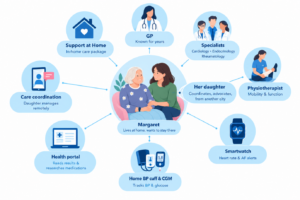
Margaret is not a prediction. She is a composite of what the data already tells us: patients are getting older, more complex, more multi-morbid, and far more digitally and health literate than any generation before them. We have enough analysis to forecast her with confidence. And that is precisely the point – the patient of the future is already known to us. The harder truth is that she is more informed than any patient in history and may not be obviously better cared for despite this fact.
So, the interesting question is not who she is. It is whether the systems we are designing today is built for her, and whether those of us in the not-for-profit health and aged care sector, whether we are willing to help redesign it.
The sector talks constantly about values-based, person-centred care, yet we’re still in early stages of the components that would make it real: actually valuing what matters most to patients. We still lack mature instruments to capture the outcomes Margaret would recognise as a good life (or a good death), such as dignity, continuity, connection, spirituality, the right to a reasonable risk. Worse, our system remains built around managing decline, including treating conditions, mitigating risk, slowing deterioration, with too little emphasis on supporting people to keep contributing, connecting and pursuing purpose across their lives. Margaret is not a bundle of conditions to be managed downward; she is someone with something to offer. A system that only knows how to measure and fund decline will keep delivering exactly that.
That is a problem of stewardship. Someone has to build and refine the instruments that collect meaningful outcomes and publish them so the whole system can learn. The care economy is a learning system – but only if we feed it. Too often we generate data without generating meaningful insight. We know now that more data does not equal better patient outcomes. Connected, well-coordinated, outcome-focused data might.
The money is harder still. Australia runs a hybrid system almost everywhere it touches people’s finances — health, superannuation, student loans. Margaret’s generation is accumulating wealth while being told they may have to make a contribution to their care. How we resolve universality against means testing is not just a fairness question but a behavioural one: the funding decisions we make today will shape how future patients save, plan, seek care and trust the system. And we must hold onto a distinction the debate keeps losing – the price of care is not the same as the cost of accessing it. If we design our instruments and funding around price alone, we will keep optimising the wrong thing.
We must also hold onto a distinction the debate keeps losing: the price of healthcare is not the same as the cost of accessing it. A service can be nominally affordable and still be out of reach – geographically, administratively, culturally. If we design our outcome instruments and our funding mechanisms around price alone, we will keep optimising the wrong thing. Both need to reckon with the true cost of access for people like Margaret.
All of this collides with an uncomfortable measurement problem. Care is no longer single-disease-driven. Margaret’s outcomes cannot be attributed to any one intervention, because her wellbeing is produced by the whole model of care built around her. That makes conventional productivity measures a poor fit. If we cannot attribute value to a single treatment, then value has to be understood at the level of the model of care itself. The real question we need to answer is how we reward higher-quality care when it genuinely meets the needs of the patient of the future -and the answer will come not from more forecasting, but from taking monitoring and evaluation seriously. That means we should be learning from and embedding those findings back into a care economy we are all helping to design.
This is where not-for-profit, mission-led providers have both a stake and a distinctive voice. The narrative about the patient of the future is being written largely by government and technology vendors, and it tends to assume that the fix is more data and more devices.
But we already know Margaret exists. She is a mother, a sister, a daughter, a friend – not just a prediction or a data point. Patients like her are already in our care.
Our contribution should be the harder, more human argument: that the patient of the future needs connected care, transitions that actually work, and a system honest enough to value what matters to people like Margaret. The task now is to build the funding design, the measurement and the workforce worthy of her – and to do it while