PAPUA NEW GUINEA COVID AID SET TO ARRIVE NEXT MONTH
August 27, 2021
CHA CALLS FOR URGENT BOOSTER SHOT APPROVAL AS IMMUNITY ‘CLIFF’ APPROACHES
September 1, 2021

Prostate Cancer is the most commonly diagnosed cancer in Australian men with about 20,000 diagnoses and close to 3300 deaths a year.
But there are few early symptoms of what can be a fatal condition, and diagnosis – leading in some cases to invasive and life-changing treatments – is not always black-and-white.
Hence there is often hesitancy to get tested, and confusion over what is required to manage it.
Now several new programs at Sydney’s St Vincent’s Private Hospital campuses could help take much of the guesswork out of handling the disease, and a new SVPH clinic will help professionals and patients deal with its ongoing treatment and share their expertise.
The prostate gland is part of the male reproductive system. Often described as the size of a walnut, it sits below the bladder and in front of the rectum.
As such prostate cancer is a male-only disease, and is why September is International Prostate Cancer Awareness Month, where all men aged 50 and over, or over 40 years if they have a family history of prostate cancer, are being encouraged to talk to their GP about being tested.
Prostate cancer is generally a slow-growing disease, and most men can live with it for a long time without painful symptoms or the cancer spreading.
Traditional prostate cancer screening, including prostate-specific antigen (PSA) testing, increases detection but is only a rough guide to how and even if to treat the disease.
Once diagnosed, what to do next is the hard part for health professionals and their patients. Can the cancer be simply left alone and monitored, or does it need treatments – surgery, radiation therapy, hormone therapy or chemotherapy – that can save a life but in some cases lead to life-changing problems with bowel, sexual and urinary functions.
Urological cancer specialist Dr Ben Namdarian is part of a St Vincent’s Private Hospital team championing new methods to both diagnose and treat this cancer.
The hospital is using cutting-edge breakthroughs in magnetic resonance imaging (MRI), PET and robotic surgery technology to test for and treat prostate cancer patients, and is developing a new clinic for higher-risk patients and those who have undergone treatment.
The hospital is using cutting-edge technology including magnetic resonance imaging (MRI), PET and robotic surgery to test for and treat prostate cancer patients, and is developing a new clinic for higher-risk patients and those who have undergone treatment.
“A lot of men have prostate cancer but they don’t die from it, they die with it,” Dr Namdarian says. “The problem is how do we determine which one is this nastyaggressive disease and which isn’t.
“MRIs have been in use for a while, and although they are not perfect they are much better than a PSA test.
“But a new primary PRIMARY study paper recently released by St Vincent’s has found that a PET (positron emission tomography) scan increases our ability to accurately diagnose and stage treatment.
“PET scans produce really good results – putting together PET scans and MRIs gives us even better results.”
Dr Namdarian says the scans help predict and accurately understand what’s going on with an individual’s cancer.
“It helps us understand who we should treat, who we should expose to the risks of those treatments,” he says.
“We are trying to get some clarity about who will actually benefit from these interventions, and those who we can safely say to ‘you’re OK, we can just keep an eye on things’ and not expose them to those risks.”
Dr Namdarian is proud that these processes are available to just about anyone, with equity of access a key SVPHA aim.
“We have been able to make sure there is parity of access,” he says.
“If you have money you can pay for whatever you like but what’s nice is that, coupled Wwith fundraising from the St Vincent’s Curran Foundation, a priority of the hospital has been to get treatment parity for everyone, so all comerspeople from all walks of life can access the latest trials, radiation technology and robotic surgery.
“Robotic surgery has been accessible here for all patients for the past two years. It means that if we need to remove the prostate, rather than a big cut through the abdomen with all the risk of blood loss and protracted recovery time, we can do it via keyhole surgery.”
Dr Namdarian says that as well as high-tech diagnosis and treatments, a new prostate cancer clinic will offer support for patients, carers and the wider health community.
“The new clinic is part of a phased roll out over the next six twelve months or so,” he says. “It will offer a lot of support for men with prostate cancer, lots of elements for the individual and their family as part of their journey in terms of dealing with sexual function, continence, mental health, and sometimes problems with mobility.
“St Vincent’s Hospital already has a great website for heart health, which is good for GPs and patients as it offers a lot of good information.
“As part of this roll out we are setting up a similar website as a portal for GPs and patients in the community with virtual care an option via the platform, we there will have be the physical clinic, and we will progressively increase the services we can provide.
“It’s really exciting that anyone from a company CEO to the man off the street will be able to access this world-class service.”
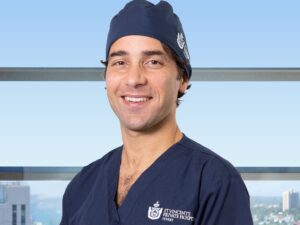
Dr Ben Namdarian