CATHOLIC AGED CARE OPERATORS STEP UP TO THE MARK ON VACCINATION TARGETS
September 29, 2021
ST JOHN OF GOD CELEBRATES 150 YEARS – REFLECTION BY MARCELLE MOGG
October 7, 2021

Professor Katie McMahon, left, and Dr Lisa Gillinder
Right-handed Queenslanders whose first language is English are being asked to put their hands up to help with a new study that may help reduce speech and language loss in epilepsy patients who need brain surgery.
The study is also seeking patients with temporal or frontal lobe epilepsy.
The project, involving the teams from the Mater Hospital Advanced Epilepsy Unit, Queensland University of Technology and the University of Queensland, will study people who have epilepsy as well as those who do not, to improve their understanding of the speech areas of the brain.
The study could also lead to improved treatment for people with other conditions including stroke, dementia and brain tumours.
Epilepsy affects more than 250,000 Australians, with one third requiring surgery to remove the brain tissue causing seizures.
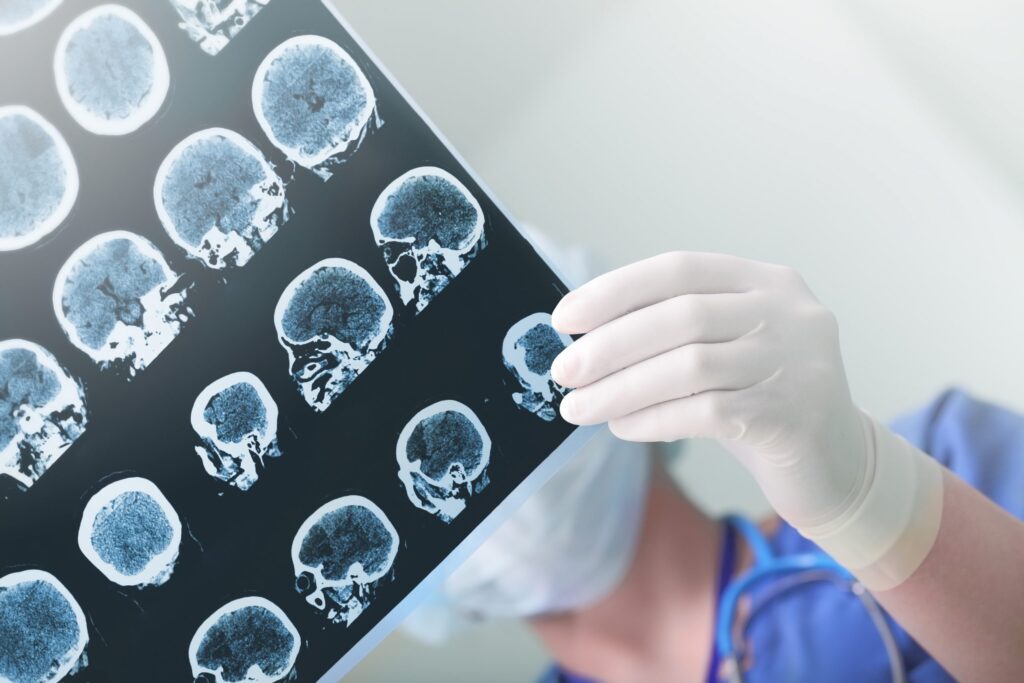
Mater Hospital Centre for Neurosciences neurologist Dr Lisa Gillinder says the study will use functional magnetic resonance imaging (fMRIs) to help researchers map areas of the brain to better understand and deal with the condition, especially as it relates to language.
Dr Gillinder is part of a team that includes: Dr Sonia Brownsett from the University of Queensland’s School of Health and Rehabilitation Sciences; Herston Imaging Research Facility deputy director and Queensland University of Technology Professor Katie McMahon; and PhD student Aoife Reardon.
“Epilepsy can sometimes affect language skills including the patient’s ability to speak or read normally or remember words,” Dr Gillinder says.
“We are trying to better understand the effects that epilepsy can have on the brain, in particular, to understand the complexity of the neural networks related to language function, because a lot of the models that are relied upon today are somewhat out of date.
“In particular these language models don’t take into account the language function located in the temporal lobe, which in epilepsy is often the most commonly affected area.”
Dr Gillinder says patients also often complain that they have language problems but standard tests aren’t always able to detect a problem.
“We suspect that the testing we are using is not sensitive enough, and the patients do have a genuine language deficit that we are not detecting,” she says.
“This presents a huge missed opportunity to provide therapy and intervention to help with language skills for our patients.”
The study findings will also feed directly into surgical planning, helping to reduce the risk of damage to areas of the brain responsible for speech and other language functions.
“If we need to do surgery in the temporal lobe, we will be better able to ask: what’s the likelihood that the patients might suffer a language deficit, can we do anything to prevent that, and what can we do to help them afterwards?
“This may involve pre-habilitation before surgery then preparing the patients for more intensive rehabilitation after surgery to make sure we maintain as much of their language skills as possible and help them recover if any deficits occur.”
Dr Gillinder says another part of the study involves using functional MRI for language mapping, which will help to identify which hemisphere in the brain contains language function and will hopefully provide greater insights into the regional location of different components of the language network.
Again, this will help identify potential issues relating to surgery and allow practitioners to minimise postoperative risks.
The researchers are calling for volunteers aged 25-65, with or without epilepsy.
So why right-handed research subjects with English as a first language? Dr Gillinder says it’s all to do with making the results of the brain mapping standardised before it is applied generally.
“Right-handed people are almost always left-hemisphere dominant, which means the left hemisphere of the brain contains language function, while in the left-handed it can be either left or right sided, or they can sometimes even have a mixed dominance.
“When we investigate we do the most common scenario first, which is right-hand dominant people, as that almost guarantees their left hemisphere contains the language function.
“As far as English as a first language, when people learn their first language we have a reasonable idea of which regions participate in that function because the network is organised in a particular way that’s thought to be fairly reproducible between people, but when we consider patients who are multilingual we don’t understand as much about the organisation of those networks.”
Dr Gillinder says the study has just begun and the team hopes to eventually enrol 80-100 volunteers.
Participants will be asked to attend two MRI scans at the Royal Brisbane and Women’s Hospital approximately two months apart. Each session will take about 1-2 hours.
So, if you can help, put your right hand up and contact Aoife Reardon, University of Queensland, on (07) 3346 6110 or a.reardon@uq.edu.au.