Our Position – Redesigning private health insurance products for value and choice
November 20, 2025
The Human Cost of Gaps in Primary Care
November 20, 2025

Opinion

By Dr Katharine Bassett
Catholic Health Australia Director of Health Policy
In the end, every grand strategy, every budget line, and every reform in health care comes down to something disarmingly simple: will this help a patient?
That’s not a slogan. It’s the only question that matters.
Australia’s health and aged care systems are among the finest in the world, but they are also among the most fragmented. A patient can receive world-class surgery in a public hospital, then get lost in a fog of disconnection between rehabilitation, home care, and community support. We have built magnificent silos; what we lack are the bridges between them.
At Catholic Health Australia, we are fortunate to see the whole landscape. Our members care for people from the first cry of life to the final breath, across hospitals, aged care, and community services. This gives us a rare vantage point: a view not of isolated systems, but of the patient’s entire journey. And what that journey tells us is clear — the future of healthcare is not being written in the wards, but in the networks that connect them.
Every part of the system matters. From the quiet precision of logistics and data systems to the compassion of the nurse, the insight of the GP, the devotion of the aged-care worker, the diligence of the policymaker. Every link in the chain shapes the experience of the patient. And when those links are joined, people feel seen and supported. When they are not, they feel lost.
The task before us is to define care for a new generation. To see the patient not as a single episode, an emergency admission or a prescription refill, but as a continuous narrative that runs through life: from health to illness, from home to hospital, from independence to support.
It is not merely an ethical vision; it is also the only way our health system will remain sustainable. Every disconnected process creates duplication. Every handover gap breeds waste.
When systems connect, care deepens. Data becomes understanding. Coordination becomes compassion.
We should never underestimate how transformative it is when a patient moves from one part of the system to another and does not have to repeat their story, when the handover feels seamless, when every professional along the way knows who they are and what they need. That is dignity. That is respect.
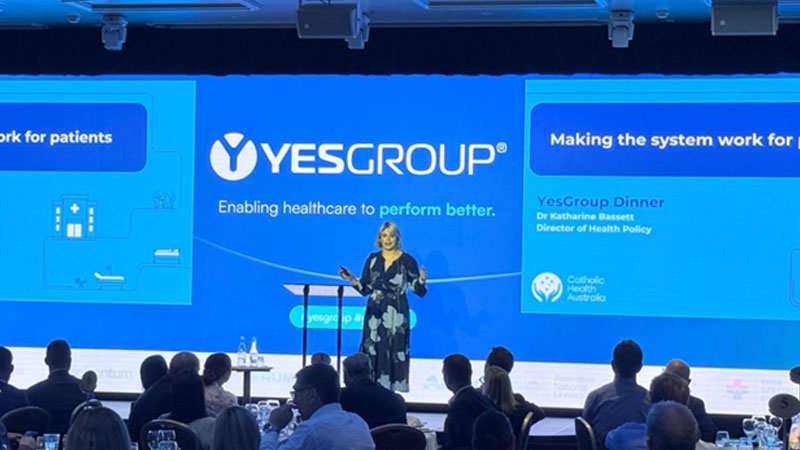
Dr Katharine Bassett recently presented at the YesGroup Forum on why we need to make the system work for patients.
Making “patient-centred” real.
At its core, patient-centred care is one of the six universal aims of a high-quality health system: care that is respectful of, and responsive to, individual patient preferences, needs, and values, and ensures those values guide every clinical decision.
Across studies, patients and providers consistently rate different things as “most important.” Patients emphasise being known as a person, clear communication, continuity, mental-health support, and not having to retell their story. Providers tend to emphasise biomedical problem-solving and process measures.
- Agenda-setting: start with the patient’s goals.
- Teach-back: check understanding.
- Shared decisions: document preferences and trade-offs.
Dr Katharine Bassett
Katharine is a respected leader committed to sparking positive change and reforming Australia’s health system. She has nearly a decade of experience developing evidence-based solutions to Australia’s biggest health and social policy challenges.